Showing posts with label Casual Friday. Show all posts

Friday, March 11, 2011

Casual Friday: A Trip to the Art Museum

As Aristotle was fond of saying, "There comes a time in one's life when one has no idea what to post on one's blog." For me, that time is now, so I'm just going to post a bunch of paintings that I like, because art is a great method of transmitting meaning and joy. I don't know if anyone else will like them and I don't know if most of these would even be classified as "happy" art, but they do all have a positive feeling to them. (You can click each one for the full-sized version.)
"First Steps (after Millet)" by Vincent Van Gogh. He painted this in 1890 while he was a voluntary insane asylum patient at Saint-Remy, where he also did some his most famous work (like "Starry Night").
"The Botanist" by Louis Wain. Louis Wain is one of my favorite painters, even though he's not really considered serious or deep by the art world (because he mostly painted cats with funny anthropomorphic features). He is also famous for becoming schizophrenic, with his cat paintings often looking completely abstract and psychedelic before psychedelic was even a word. You can check out other Wain paintings at Catland.
"Every Girl Should Have a Unicorn" by Dr. Seuss. Many people don't know this, but the famous children's author and artist Dr. Seuss also made paintings for adults--he just didn't release them usually. Well, his "adult" paintings are just as colorful and imaginative as the ones in his children's books, if not more so. You can see them in the excellent book The Secret Art of Dr. Seuss.
Hopefully these are some paintings you haven't seen before. I'm keeping it short so YOU feel free to post any paintings you like in the comments!

Friday, February 18, 2011

Casual Friday: The Blog Turns 100! And SPECIAL REPORT on the Roxie

Here's a photo of the blog today. From Trustar Vibrations.
Yay! Today the blog turns 100! Well, not 100 YEARS old, but 100 POSTS. Yes, this is my 100th post here, and I intend to use it in the laziest way possible.

If you don't want to be as lazy as me, go to San Francisco tomorrow. Why? Because you can see a "sneak-preview" screening of the documentary HAPPY at the Roxie Theater at 7:00 pm. Director Roko Belic will be there, and so will Melissa Moody, one of the people featured in the movie. They will hold a Q&A session after the film.

Tickets are $10, or $6 for seniors. You can order online or see more info at the Roxie website. You can also pay at the box office. As this is a non-profit, fully independent film, proceeds go toward a proper theatrical release (expensive costs borne by a movie studio or distributor on most films).

Remember:  Tomorrow, February 19, 7 pm, at this address:

Roxie Theater
3117 16th Street
San Francisco, CA 94110
(415) 863-1087

Hope you can make it!

Friday, February 11, 2011

Casual Friday: Foods That Make You Happier

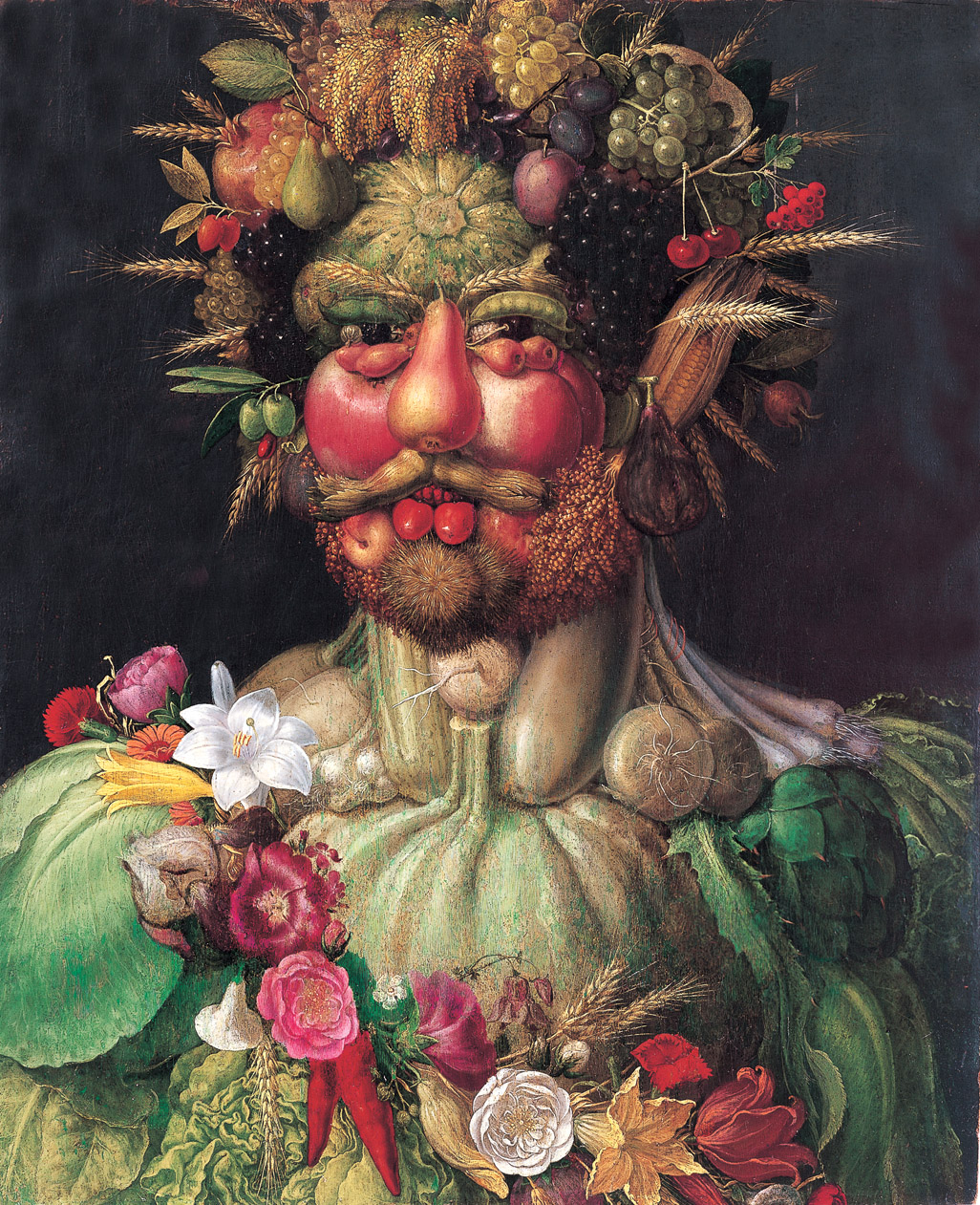
You are what you eat! Don't you want to look
like this? Portrait by Giuseppe Arcimboldo.
From Wikipedia.
Today I thought it would be nice to highlight diet tips that can improve your mood, using this article by Elsa Jones from Herald.ie and this article by Mary Bourgeois from Top Wire XS as guidance. As most of you probably know, food can have a big effect on levels of your serotonin, also known as the "happiness hormone" (even though it's a neurotransmitter, not a hormone). But what kind of diet is best? Let's find out!

  1. Eat folate-rich foods. A study by the University of York and the Hull York Medical School showed that low folate levels can lead to depression, so eat foods like peas, bananas, oranges, broccoli, and others like them.
  2. Eat protein with every meal. Protein-rich food keeps blood sugar balanced and contains tryptophan, which is necessary for serotonin production. Some good foods in this category are turkey, cottage cheese, and bananas.
  3. Eat B vitamins, especially B6. B vitamins help with serotonin production, but B6 also helps in the metabolism of red blood cells. B-vitamin foods include oats, leafy green vegetables, and eggs.
  4. Eat omega-3 foods, like fish. A study by the Journal of Clinical Psychiatry showed that eating fish capsules three times a day improved bipolar and depression patients' moods after eight weeks. This makes sense because omega-3 helps create dopamine (another neurotransmitter related to happiness) and slows the breakdown of serotonin.
  5. Eat vitamin D. Most of us don't get enough vitamin D from sunlight, especially in the winter, which can cause problems because this vitamin is a mood booster. Some good vitamin-D foods are oily fish, leafy green vegetables, and eggs.
So there you have it. Give some of these tips a try. You'll probably be glad you did!

Friday, February 4, 2011

Casual Friday: Loneliness

From Wine Press of Words.
Today is Friday, a day when many people try to put away their stress and go out with friends, so it seems as good a time as any to discuss the importance of social interaction. I'll be using the excellent book loneliness:  Human Nature and the Need for Social Connection by John T. Cacioppo and William Patrick for most of my information, so read that if you want to look deeper.

Most of you probably realize that habitual social isolation affects health negatively, but you may not know to what extent. According to a study done by epidemiologist Lisa Berkman, people with few social ties are two to three times more likely to die of ischemic heart disease, circulatory disease, cancer, respiratory failure, gastrointestinal failure, and all other causes of death. This makes extreme loneliness just about as dangerous as obesity, lack of exercise, or smoke inhalation.

Many researchers were skeptical of such harsh results, but studies since then have supported them. One of the most extensive studies of loneliness was conducted by the authors (Cacioppo and Patrick) themselves. At Ohio State University, they gave volunteer test subjects a battery of tests, including not only daily surveys of their subjective wellbeing, but also objective physiological measurements like blood tests, salivary gland tests, and even sleep tests. The results show that lonely people (especially older people) experience chronic stress at a 25% higher rate, and this stress compounds over a lifetime. On brain scans they are even less happy than normal when they DO finally experience social connection.

Okay, so now that (I hope) I've convinced you that loneliness is a serious health problem, what counts as loneliness? The authors define it as a lack of meaningful social interaction. The interaction has to be meaningful because people standing in a crowded mall can be just as lonely as someone alone in a basement, if not more so. If you feel better with a small group of friends than a large one, that's okay. It's the quality of the interaction that counts, not the quantity.

As for how to get out of a lonely slump, that's a difficult question. You might start by looking for people with similar interests as you. I recommend the website Meetup, which allows you to find groups and clubs in your area, then meet them in person. The important thing is to keep trying, even if it doesn't seem to go well at first (loneliness can amplify negative feelings of yourself, even when you have no cause for concern).

This post is already rather long, so might as well go read the book at this point. Just remember that everyone goes through these feelings at some point, so even if you're lonely, you're not alone.

Friday, January 28, 2011

Casual Friday: "Happiness Tips for the Unemployed"

Thankfully the streets don't look like this
just yet. From The Omaha Project.
It's been awhile since I've read any new books relating to happiness, so again I turn to the Internet for guidance. Today I found this interesting article by Aaron Jacobsen and Michelle Santos of Tiny Buddha. It's a list of five tips to help you avoid despair if you are unemployed (which you very well might be, according to the latest figures).

Some of these tips may be common sense, but even if they are, hearing/reading them from an outside source can help. Again, you should read the actual article for explanations, but here is a summary of the list:

  1. Identify your emotions. When you think about what you're feeling and give it a label you can act accordingly instead of reacting impulsively.
  2. Keep going to social activities. Negative emotions tend to amplify in isolation.
  3. Try to think positively. This may be hard to believe, but studies show that positive thinkers actually have a more accurate view of the obstacles in their life, while too many negative thoughts can give you tunnel vision.
  4. Stay open to different career paths. You'll find more opportunities if you're willing to change from a banker to a nurse (for example) than if you always try to stick to one career.
  5. Take advantage of your free time. This may sound a bit callous, but losing your job DOES give you more free time. Since you're not on the job from 9 to 5 anymore, you might as well take advantage of your free time by doing any hobbies that make you happy or by developing any of your lesser-used skills.
Anyway, these are just some tips to keep in mind. Just remember that getting back on your feet may be difficult, but it doesn't have to be impossible!

Friday, January 21, 2011

Casual Friday: "9 Easy Ways to Be Happier"

From Real Simple.
In my quest to do as little work as possible, sometimes it's nice to have a helping hand. Today I can get away with even less work than usual because Julia at The Thank You Project tipped me off to this article by Marcia Menter from Real Simple. It's a look at nine easy ways to be happier.

You should go to the actual article to look at the pretty pictures and read the explanations, but here's a summary of the list:

  1. Cool yourself off. Cool temperatures apparently produce better moods than hotter temperatures (could have fooled me).
  2. Remember happy times in your past. Nostalgia can be a great mood booster.
  3. Don't obsess over past failures. This goes hand-in-hand with the previous tip.
  4. Give away money. As I've said before, generosity toward others makes YOU feel happier.
  5. Eat a snack around 2 p.m. This is the time of day when serotonin levels dip, and a snack can help.
  6. Exercise. It boosts mood and helps your brain.
  7. Limit your choices. This may be counterintuitive, but too many options at once can produce unnecessary stress.
  8. Learn a new skill. This gives you variety and sense of accomplishment.
  9. Make your bed. Eh? Well apparently doing little tasks like this can make you more satisfied throughout your day.
Anyway, it's a good, easy list with some stuff I've never read before. Also, I love getting tipped off because it means I don't have to scrounge around for something to post! If you'd like to make my job easier, go ahead and tip me off to interesting articles, books, or videos in the comments section or through email. See ya!

Friday, January 14, 2011

Casual Friday: Eiji on CNN Asia

From CNNGo.
Today we have a very interesting story that many of you already know, but it's cool to see in the media anyway. Our friend and producer Eiji Han Shimizu was featured on CNNGo, CNN's Asian division. Eiji is known for creating BioGraphic Novels, his line of graphic novels about real life heros like Gandhi and Mother Teresa. Also featured is Tom Shadyac, one of the most successful comedy directors ever and our executive producer.

Anyway, the story is pretty good, and features pictures that even I haven't seen, so give it a read!

Friday, November 19, 2010

Casual Friday: Run!

From Barefoot Ted, one of the
people in the book.
Today I'll talk about Christopher McDougall's excellent Born to Run. It's very popular, so you may have read it already, but it's so good I have to bring it up again. It's a non-fiction book about modern ultramarathoners running a race against the Tarahumara, a Mexican tribe with (apparently) superhuman running abilities. The "plot" is set up like any great sports movie, so it's exciting to read as well as educational.

Christopher's general thesis is that we humans are literally born to run, in that running possesses the secrets to our evolutionary survival and lifelong wellbeing. Not to get all cosmic on you, but running may be the reason that we exist at all. The book goes into the evolutionary divergence between Homo sapiens (us) and the Neanderthals. Spoiler alert:  we survived and they didn't, probably because our bodies are made for running, allowing us to develop our intelligence instead of physical strength.

I've written before about the emotional and neurological benefits of exercise. Running carries the most benefits, but you have to do it right so you don't get injured. Basically, everything you think you know about shoes is wrong. According to the book, high-end running shoes make you 123% MORE prone to injury. So what can you do?

Run barefoot!

Yes, apparently the natural musculature of the human foot is the best running shoe there is. Professional running shoes, with all their padding and rubber, block your feet from doing their job. Tiny scrapes on your feet are minor compared to the knee and bone injuries that you could suffer if you run with too much shoe padding. People may look at you funny, but your legs will thank you. Just make sure you run on grass in the beginning! Also, don't pay too much attention to your timer. Running should be a joy, not homework. Interestingly, running for no reason will probably make you faster anyway, and will certainly make you more likely to continue running over time. Like the Tarahumara, you can live longer, and continue running marathons well into your sixties!

So why are you still at your computer? Run!

Friday, November 5, 2010

Casual Friday: The Importance of Meaning

From Extreme Kindness.
In his book Happier, Tal Ben-Shahar relates this thought-experiment by the philosopher Robert Nozick:  Imagine a machine that could give you the feeling of any experience you could possibly imagine. It could give you the feeling of a vacation in the Riviera, the feeling of directing a great movie, the feeling of discovering a cure for cancer, the feeling of being in love, or any other infinite number of feelings. If such a machine existed and the feelings it created were perfect replicas of the real things, would you choose to stay plugged into it for your entire life? Would you be happy staying plugged in?

Most people would say no. Even though humans desire pleasure, we also intuitively know that pleasure alone is not enough for longterm happiness. We desire to make a REAL difference in the world, no matter how small that difference may end up being. So as long as you know that the "experience machine" is not real, you would almost certainly feel a nagging incompleteness if you stay plugged in for a long time. (But if you don't realize you're in a machine, like a citizen in The Matrix, that might be a different story.)

So how do you create meaning in your everyday life? Not everyone has an obviously meaningful job like cancer researcher, but meaning is still within your reach in the billions of small moments you experience throughout your day. Tal Ben-Shahar suggests that you make a list of the things you find meaningful, then list the things that give you pleasure, then list your strengths as a person. When something shows up in all three categories, that's what you should spend your time doing, even when it seems insignificant to other people. This is the most basic recipe for longterm happiness there is, but it takes effort.

I think it's worth it, though.

Friday, October 29, 2010

Casual Friday: Do Random Acts of Kindness!

From Drive.
Hello and good Friday to all you in Internet-land! Today I have a very important happiness tip:  give to other people! The concept may seem obvious, but scientific evidence backs it up. Doing things for other people makes you happier.

Sonja Lyubomirsky and her team studied this in 2004. She had a group of test subjects put quarters into strangers' parking meters. By measuring the test subjects' happiness levels before and after the quartering (and comparing them to those of a control group, of course), she found that performing kind acts really does make people happier. Some call it a "giver's high." It works even if the recipient of the kind act isn't aware that you did anything (or that you even exist)!

Interestingly, Sonja's tests show that the best way to perform kind acts is to do a bunch of them all in a single day, instead of spreading them out over a week. The reason may be that pushing yourself to do one act every day becomes too routine, while doing around five all at once is more spontaneous, which keeps things fresh and makes you more likely to be kind in the future.

So give kindness a try. It can be as simple as putting quarters in a stranger's parking meter!

(For more details on this experiment and many others, check out Sonja's book, The How of Happiness.)

Friday, October 22, 2010

Casual Friday: Flow

Welcome to Friday, everyone! Today I'm going to discuss flow and how it affects happiness. Flow is a concept proposed by psychologist Mihaly Csikszentmihalyi (don't even ask me how to pronounce that) in his 1990 book Flow:  The Psychology of Optimal Experience.

So what is flow? Even if you don't know what it is, you've probably experienced it at some point in your life. It's basically the feeling of losing yourself in an activity that you are excellent at. Some people describe it as being "in the zone." Along with social connections and an optimistic viewpoint, positive psychologists consider regular experience of flow to be one of the most important components in longterm human happiness.

Here is a basic recipe for flow (from Wikipedia):

  1. One must be involved in an activity with a clear set of goals. This adds direction and structure to the task.[8]
  2. One must have a good balance between the perceived challenges of the task at hand and his or her own perceived skills. One must have confidence that he or she is capable to do the task at hand.[8]
  3. The task at hand must have clear and immediate feedback. This helps the person negotiate any changing demands and allows him or her to adjust his or her performance to maintain the flow state.[8]

Maybe you do all of these things already, so this recipe is a bit like stating the obvious in more difficult language. In that case, just keep doing what you're doing! The thing I like about flow is that it's not dependent on other people, like social connections and other forms of happiness may be. So even if your friends aren't around, you can still be happy and productive. Just lose yourself in your favorite activities!

(On a slightly unrelated blogging note, be sure to check out 5 Minutes for Mom and Jenny on the Spot, especially all you parents out there!)

Friday, October 1, 2010

Casual Friday: Can We Be TOO Happy?

Today is kind of a change of pace for this blog. It may seem like a bit of a downer, but bear with me here. Longtime readers probably realize by now that I'm not in favor of acting happy when you're not, but now I'll discuss why, using Ed Diener's book Happiness:  Unlocking the Mysteries of Psychological Wealth.

Ed Diener has researched happiness for twenty-five years. He and his son Robert--the co-author of this book--travel the world measuring wellbeing. They often risk life and limb to measure fringe populations, like sex workers in India and the homeless in California, which has earned Robert the nickname "Indiana Jones of psychology."

Ed devotes an entire chapter to the subject of over-happiness. He writes of an experiment where a group of New Yorkers said "yes" to every request for a month. This group thought that such a display of positivity would make everyone's lives better, but actually by the end of the month, they had LOWER happiness levels due to exhaustion. They were simply too spent after a month of getting coffee for people, babysitting, and other menial tasks that people asked them to do. Even though I have documented the numerous benefits of a happy lifestyle on this blog, Diener writes that extremely EXTREMELY happy people actually have decreased lifespans, possibly because they're so blissed out they don't notice actual health problems.

So if you are a happy person who worries about becoming even happier, don't! Experiencing complete ecstasy every moment of every day is not necessarily a sustainable goal, and may leave you burnt out in the end. In my opinion, you have to leave room for sadness and other "negative" emotions, because those are the ones that alert you to real problems in your life. Don't just ignore them!

It's like when you burn your hand on the stove. The pain may be, well, painful, but without it, you would never know to get your hand away from the hot surface. You don't want a cooked hand, do you!?

But what do YOU think about this idea of over-happiness?

Friday, September 24, 2010

Casual Friday: Happiness Fit

Do you think a lot of this happiness stuff is cheesy? That's okay:  so do I. And so does Sonja Lyubomirsky. Luckily, this doesn't mean we're walled off from the benefits of happiness science; it just means we need to find happiness activities that fit our personalities.

Sonja Lyubomirsky is one of the world's leading happiness researchers. In her book The How of Happiness, she includes a test for those of us who think a lot of positive psychology is cheesy:  "The Person-Activity Fit Diagnostic." This test asks you to assign number values to 12 activities shown to increase happiness. You can see a PDF version of the test here. Read the document for further instructions.

So give it a try. The test will give you ideas on how to meaningfully increase your happiness in the least cheesy way possible. This is important because if you're going to continue these activities over the long term, you shouldn't have to feel like a big cheesy idiot!

Friday, September 17, 2010

Casual Friday: Meditation

Hello and welcome to Friday! Today I'll give a brief introduction to the benefits of meditation using Yongey Mingyur Rinpoche's The Joy of Living. Born in Nepal in 1975, Yongey is one of the many Tibetan Buddhists to embrace modern science. He is also a best-selling author that is remarkably good at explaining the marriage between the two traditions.

In The Joy of Living, Yongey recounts a study by the neuroscientist Richard Davidson that tested meditation's effect on the brain. Davidson recruited test subjects from a Midwest corporation, hooking them up to an EEG and fMRI to measure their brain activity. He then gave the test group a ten-week course in beginner's meditation (leaving the control group alone, of course). The results were astounding. Even this short experiment produced significant electrical increases in the pleasure centers of the test subjects' brains. They felt happier, calmer, and more compassionate toward others. In blood tests, they also had a higher number of antibodies in their immune system.

So how do you meditate? Well, it's pretty simple actually, but it might not be easy. It's simple because all you need to do is calm your mind. Unfortunately for most of us, that takes practice.

Here's a simple method to get you started:

  1. Sit in a comfortable position.
  2. Really notice what thoughts are going through your head, but don't get attached to any of them. Just let them pass through your mind.
  3. If you want something to focus on, try counting your breaths without letting other thoughts come in. If you get distracted, that's okay. Gently remind yourself to keep counting.

That's pretty much all there is to it. As I said, this is a brief introduction, and other people are better at explaining it than me. The important thing is to PRACTICE. Like most things in life, meditation becomes easier and better the more you do it. Over time, it can actually change the physical structure of your brain for the better (see neuroplasticity).

Anyway, have a happy and calm Friday!

Friday, September 10, 2010

Casual Friday

Hey, it's a new weekly feature! Actually since this blog is only 48 hours old, all features are new, but this one is especially so. Since it's Friday, I thought it might be nice to take a break from discussing current happy science news. Instead, I'll use Casual Fridays to share some quick and easy happiness tips--all based on scientific evidence, of course.

On this casual-est of Fridays, I've picked the book Happier:  Learn the Secrets to Daily Joy and Lasting Fulfillment by Tal Ben-Shahar. Mr. Ben-Shahar became famous for teaching "Positive Psychology" at Harvard, a class that filled up with 855 students in a single semester. In addition to writing several books on the subject, he has also appeared on The Daily Show:  http://www.thedailyshow.com/watch/thu-august-9-2007/tal-ben-shahar.

In a nutshell, Happier is a guide to creating happiness by balancing what you want now (pleasure) vs. what you want in the future (meaning). To be as happy as possible, you should, do things that are both pleasurable and meaningful at the same time. For instance, watching TV is pleasurable, but not particularly meaningful (unless you're watching The Wire, the greatest show ever!), so it won't make you happy in the long run. On the other hand, volunteering to clean up toxic sewage may be meaningful, but not pleasurable, so if you do it everyday you'll get burnt out before you feel long-term happiness.

To help you balance pleasure and meaning, Ben-Shahar suggests that you create a chart for yourself, mapping out your activities throughout the day and assigning a number value (on a scale of 1 to 5, 1 being the lowest) to each activity's meaning and pleasure. So you might give "Watching TV" a 2 in the "Meaning" column and a 4 in the "Pleasure" column. Then write down how much time per week you spend doing each activity. At the end of the week, look at your chart and try to make a commitment to spend more time doing activities with high scores in both "Meaning" and "Pleasure", and less time doing activities with low scores.

Whew. That may seem like a lot of work, but it only takes a few minutes per week, and it can be an eye-opening experience to actually look at the time you waste doing stuff that's not meaningful or pleasurable. Like tallying up your expenditures for the week, actually seeing the numbers in front of you can make a huge difference in creating positive change.

So give it a try, then send us a comment to tell us how it goes--as long as commenting rates high enough on your chart.